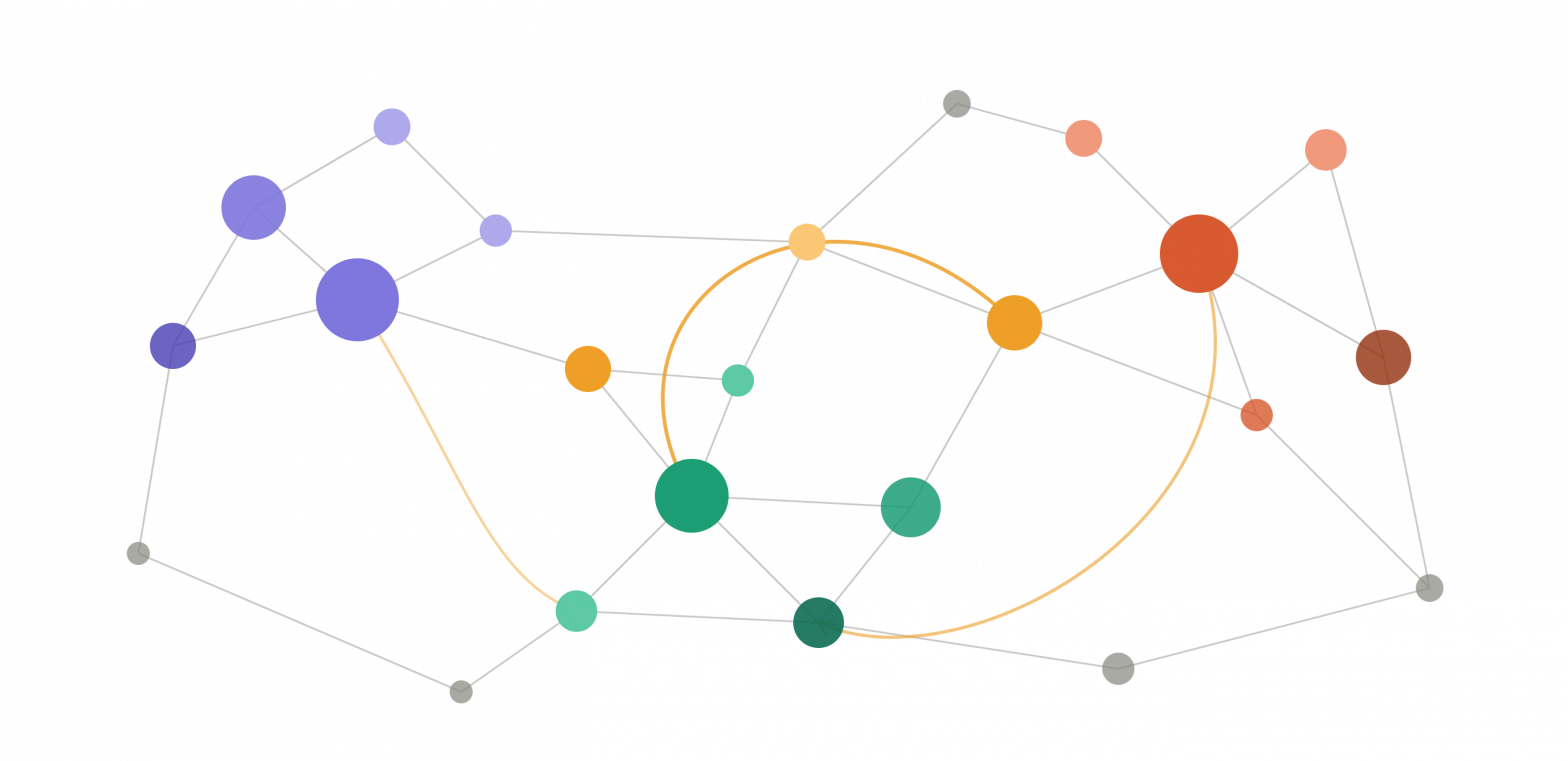
Consensus on the importance of systems thinking (ST) as a key competence in (sustainability) education has outpaced consensus on its measurement. In a Scholarship of Teaching and Learning (SoTL) project, Robert Kordts, Birgit Kopainsky and I screened existing instruments for quantitative output, domain-general scope, and feasibility with larger cohorts. Three of fifteen met all criteria. We administered two of them, Davis and Stroink (2016) for cognitive aspects and Camelia and Ferris (2018) for affective aspects, to 65 master’s students at the University of Bergen, Norway.
Key takeaways
- Both instruments work outside STEM, though two affective subscales showed weak internal consistency (α = .62 and .63), which limits their validity.
- Disciplinary background predicted nothing: neither study program nor faculty produced significant differences.
- Only one subscale, preference for whole-of-system perspectives, differed by gender, with female students scoring higher. Age showed at most a weak negative tendency (p = .09).
- Practical upshot: a brief pre-course assessment replaces assumptions about who “already thinks in systems” with concrete data.
Limitations include a single institution, a small self-selected sample, and a rapid rather than systematic review. Longitudinal follow-ups are in preparation.
📚 Read on here:
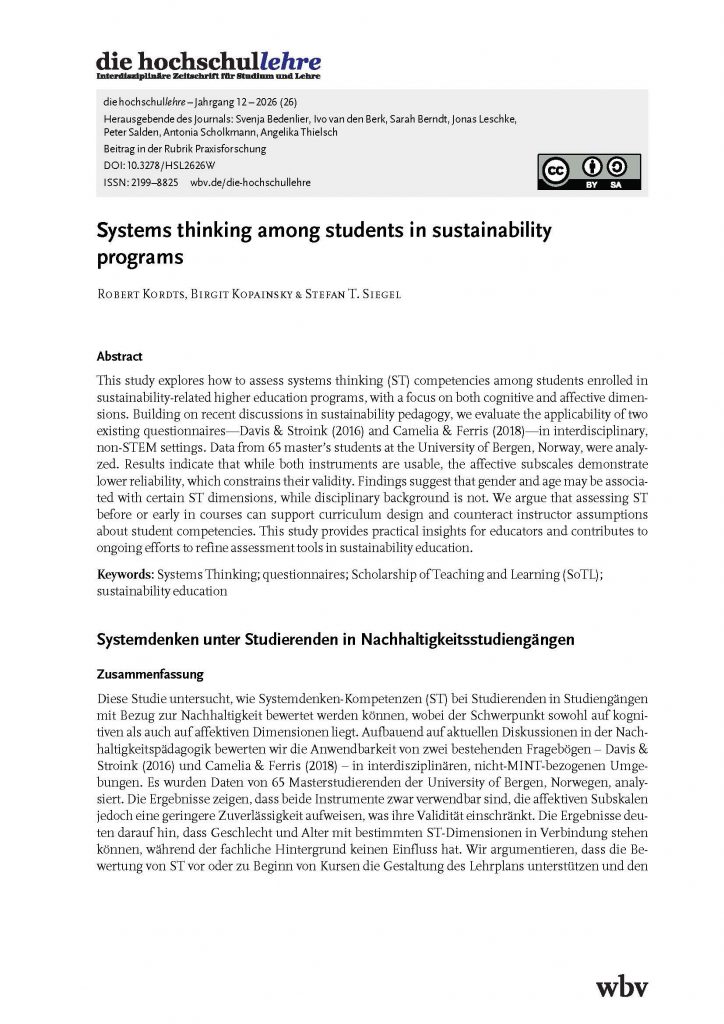
- Kordts, R., Kopainsky, B. & Siegel, S. T. (2026). Systems thinking among students in sustainability programs. die hochschullehre, 12/2026. https://doi.org/10.3278/HSL2626W | https://www.wbv.de/shop/Systems-thinking-among-students-in-sustainability-programs-HSL2626W (Open Access, CC BY-SA)